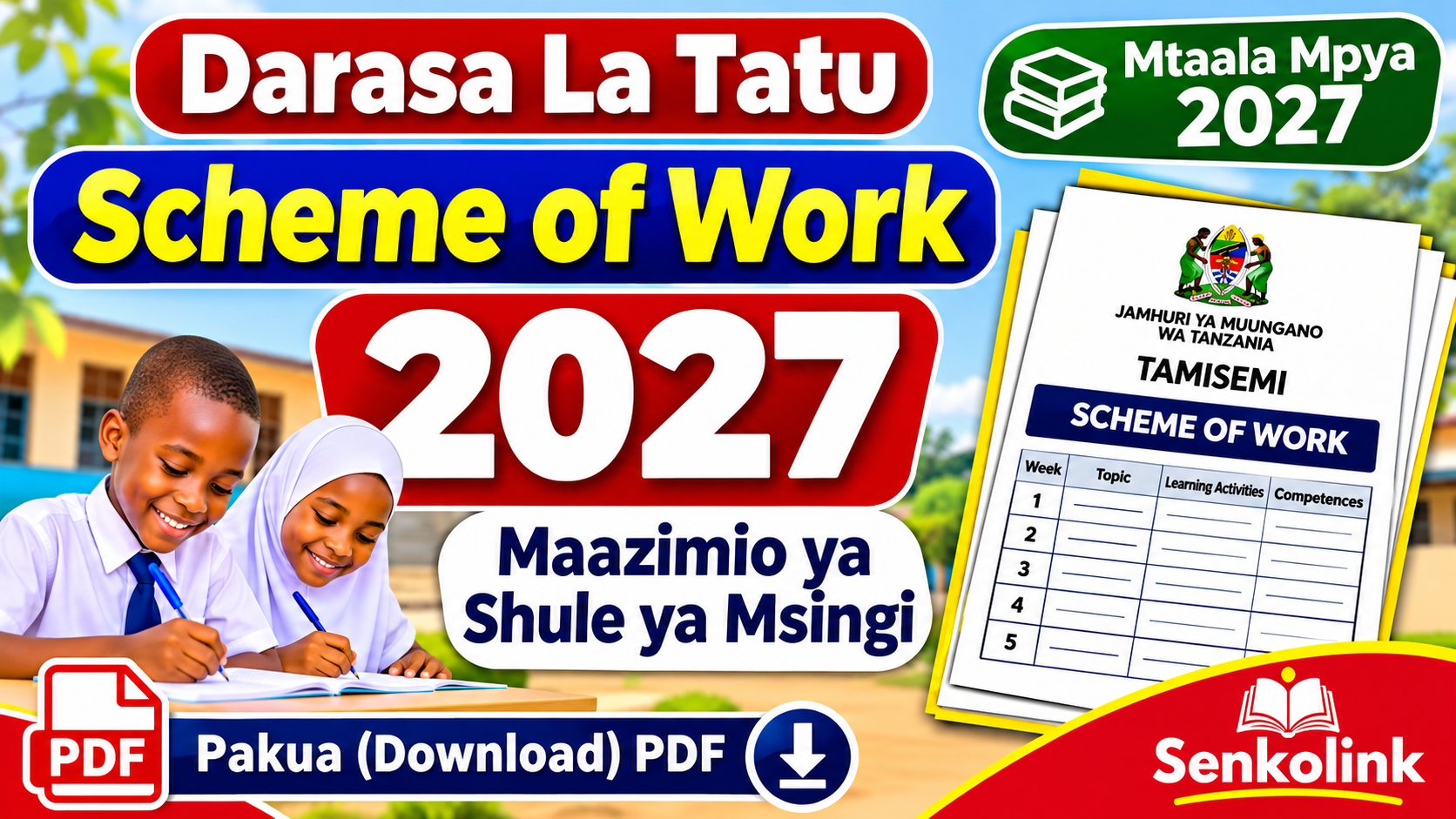
Darasa La Tatu Scheme of Work 2027 – Sayansi
Primary School Scheme of Work 2027: Maazimio ya Shule za Msingi – New Curriculum. Are you looking for Primary School Scheme of Work 2027 (Maazimio ya Shule ya Msingi 2027)? This page provides information about schemes of work for primary and pre-primary school teachers, including teaching plans prepared according to the new curriculum.
Teachers can use a scheme of work to organise teaching and learning activities, plan lessons, monitor curriculum coverage and assess pupils’ progress throughout the academic year.
Scheme of Work 2027 – Maazimio ya Shule ya Msingi
A Scheme of Work is a detailed teaching plan that outlines the structure, content and sequence of teaching and learning activities for a particular subject or course over a specified period, such as a term or academic year. In primary and pre-primary education, schemes of work help teachers organise lessons according to curriculum requirements and the learning needs of pupils.
Importance of a Scheme of Work
- Guides lesson planning: Helps teachers prepare and deliver lessons effectively.
- Ensures curriculum coverage: Promotes consistency and proper sequencing of topics and learning activities.
- Supports assessment: Provides a framework for assessing and evaluating pupils’ learning progress.
- Improves learning outcomes: Helps teachers organise activities that support pupils’ knowledge, skills and achievement.
Key Requirements for Preparing a Scheme of Work
1. Curriculum Alignment
The scheme should follow relevant national curriculum requirements.
2. Appropriateness for Learners
Teaching activities should match pupils’ age, developmental stage, learning abilities and previous knowledge.
3. Clear Organisation and Structure
Topics, subtopics and learning activities should be arranged in a logical sequence.
4. Flexibility
Teachers should make appropriate adjustments depending on pupils’ learning needs, available resources and classroom conditions.
5. Regular Review and Evaluation
Teachers should review schemes regularly, assess progress, identify challenges and make necessary improvements.
Additional Considerations When Preparing Maazimio
Assessment
A scheme should indicate how pupils’ learning will be assessed and whether expected learning outcomes have been achieved.
Teaching and Learning Resources
Resources may include textbooks, teaching aids, charts, technology and other learning materials.
Differentiated Learning
Include strategies to accommodate pupils with different learning abilities, needs and levels of understanding.
Download Darasa La Tatu Scheme of Work 2027 – Sayansi
Click the subject title below to access and download the teaching plan.
Scheme-of-Work-2027-Class III-Sayansi
🟢 BUY SCHEMES OF WORK CLASS III (DARASA LA TATU) 2027 – WHATSAPP
Pre-Primary School Scheme of Work 2027
Pre-primary teachers can also use appropriately prepared schemes of work to organise learning activities according to children’s developmental stages and relevant curriculum requirements.
DOWNLOAD PRE-PRIMARY SCHEME OF WORK 2027
Frequently Asked Questions (FAQ)
1. What is a Scheme of Work?
A scheme of work is a teaching plan that organises subject content, topics and learning activities over a specified period.
2. What is Maazimio ya Shule ya Msingi?
Maazimio ya Shule ya Msingi are teachers’ planned teaching activities and curriculum coverage schedules for primary school subjects.
3. Why do teachers need a Scheme of Work?
It helps teachers plan lessons, organise teaching activities, cover the curriculum and assess pupils’ learning progress.
4. Are these schemes for the new curriculum?
Teachers should ensure each downloaded scheme follows the applicable curriculum and correct class level.
5. Can pre-primary teachers use a Scheme of Work?
Yes. Pre-primary teachers can use suitable teaching plans according to the requirements of pre-primary education.
Conclusion
A well-prepared Scheme of Work is an important resource for effective teaching and learning. Teachers should use Maazimio ya Shule ya Msingi 2027 to organise classroom activities, monitor curriculum implementation and support pupils’ academic development.
Visit Senkolink for educational materials, teaching resources, schemes of work and other updates for teachers.